
Animal guides
Why Do Platypuses Have Bills? Not a Beak, Not a Duck
The bill is a soft, skin-covered sense organ that finds prey by touch and electrical signals while the eyes are shut. The resemblance to a duck is in shape only.
By An Nguyen · Published · Updated
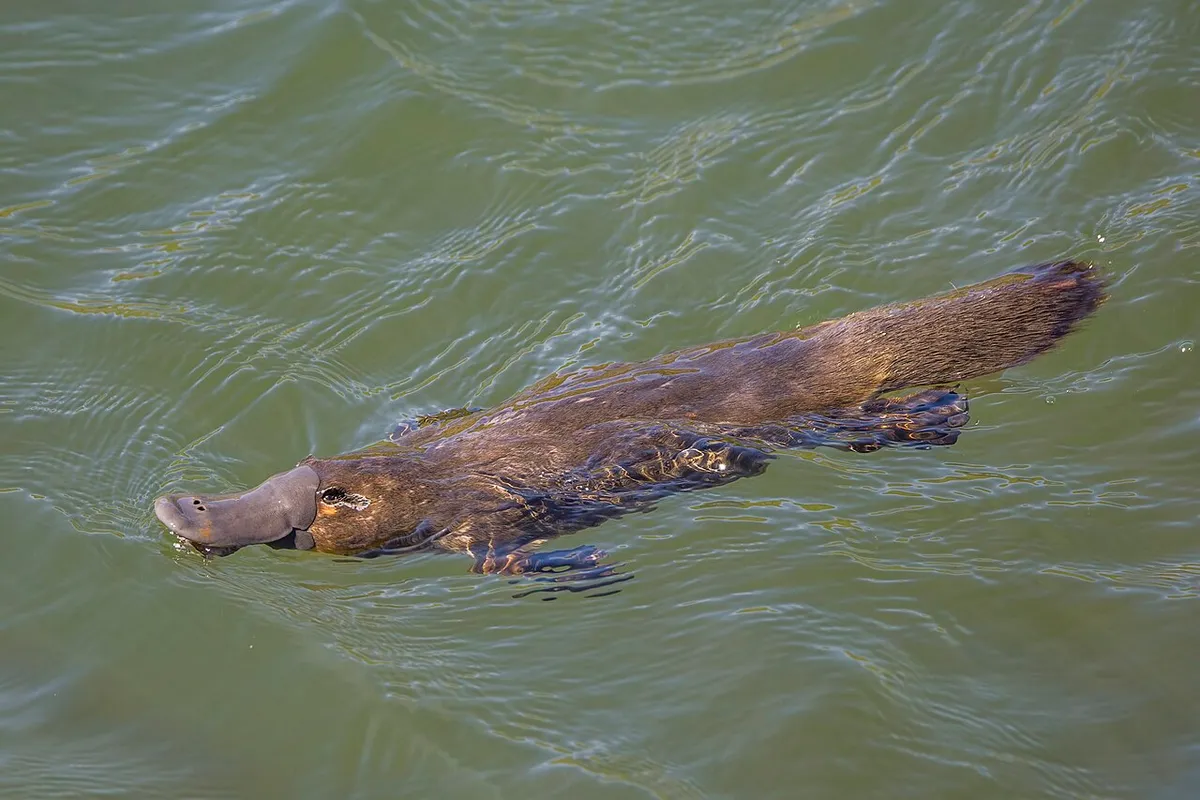
Platypuses have bills because they hunt underwater with their eyes, ears and nostrils shut, and the bill is the organ that finds the food. Its soft skin holds about 40,000 electroreceptors, which detect the weak electrical signals made by the muscles of moving prey, and more than 40,000 touch-sensitive "push rods" that register contact and small movements in the water. The wide bill spreads those receptors over a large surface, so a platypus can locate insect larvae, worms and freshwater shrimp in murky streams and lakes, mostly at night.
The likeness to a duck is in outline only. A duck's bill is hard; a platypus bill is soft, flexible and leathery. The platypus is an egg-laying mammal, and like all mammals it belongs to a lineage that split from the one leading to reptiles and birds about 315 million years ago.
Is it a beak or a bill?
Bill is the more accurate word, and it is the one used by the Australian Museum, San Diego Zoo Wildlife Alliance, Animal Diversity Web and the Australian Platypus Conservancy. "Beak" is common in everyday speech, but it suggests a bird's beak, which is a bony skeleton covered by a hard, keratinized sheath. The platypus bill is covered in smooth skin with a soft, suede-like texture, is pliable and fleshy around the edges, and has the nostrils at its tip.
The duck comparison is built into the animal's names. In the scientific name Ornithorhynchus anatinus, the genus name means "bird-like snout" and anatinus is Latin for "duck-like"; "platypus" itself comes from Greek words meaning "flat foot". The short-beaked echidna, one of the platypus's only living relatives, has the same naming quirk: its "beak" is a snout. That snout has only about 100 electroreceptors at its tip, against an estimated 40,000 in the platypus bill.
How does the bill find prey?
When a platypus dives, its eyes normally close automatically, and its ears, which sit in a muscular groove, are pinched shut. From then on the bill does most of the sensing. Two kinds of receptors work together:
- Electroreceptors. Modified mucous glands in the skin of the upper and lower bill respond to the faint electrical fields produced when a shrimp or insect larva contracts its muscles. Estimates put their number at about 40,000.
- Push rods. More than 40,000 small columns of compacted skin cells, spread over the upper and lower bill and densest along its edges, sit on top of touch and vibration receptors. Displacing the tip of a push rod by as little as 20 microns (0.02 mm) is enough to fire its nerve.
The two signals arrive at different times. Electrical signals travel much faster than pressure waves in water, so the electroreceptors register a shrimp's tail flick slightly before the push rods do, and the gap grows with distance. Researchers have found neurons in the platypus brain that respond to combined electrical and mechanical stimulation arriving with a delay, and proposed that this lets the animal judge how far away the prey is. Direction comes from processing signals across the thousands of receptors on the bill's surface. According to the Australian Platypus Conservancy, a platypus can sense the water movement of a freshwater shrimp from at least 15–20 cm (6–8 in) away, and possibly up to 50 cm (20 in).
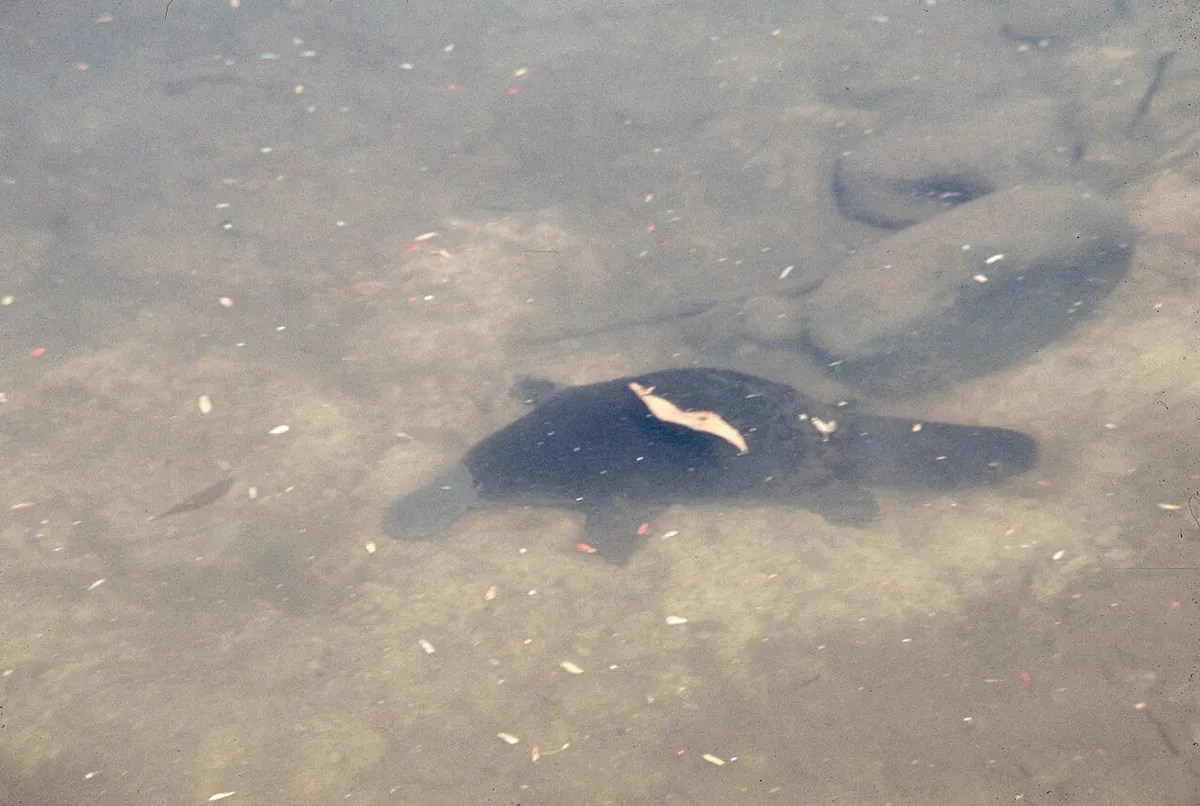
Photo by Warren Garst via Wikimedia Commons, CC BY-SA 4.0.

Why is the bill wide and flat?
The shape suits a sensor. With receptors spread across a broad surface, the bill registers how an electric field fades from one part of the bill to another. A 1998 study that analyzed the bill as an antenna found that combining receptor responses to this fall-off can produce a directional response similar to the one measured in platypuses, and that some information about the distance to the source is available in theory.
The bill is also a working tool. A foraging platypus swims to the bottom and uses its bill to find and seize prey. The catch goes into cheek pouches rather than being swallowed at once; the platypus then surfaces and chews it between horny grinding plates, because adults have no teeth.
Why does a platypus need such a sensitive bill?
Platypuses feed mainly at night, often in murky water, and their eyes are shut during each dive. Vision matters mostly at the surface, where a platypus watches for predators and will often dive instantly if a bird swoops overhead.
Their foraging schedule also demands an efficient search. A dive usually lasts less than 60 seconds before the animal returns to the surface for air, and a platypus most often feeds in one long session of 8 to 16 hours. Estimates of daily food intake are about 15% to 28% of body weight in captivity and 19% for wild platypuses in a Tasmanian lake. Collecting that much food in short dives with the eyes closed depends on a bill that can locate small, hidden prey quickly.
Why do platypuses look like ducks?
Two features carry the comparison: the bill and the webbed feet. Both suit an animal that feeds in water, but they do not indicate a relationship with ducks. The platypus has fur, and females feed their young on milk, although they have no nipples: the milk is secreted from two patches of skin onto the belly fur.
Europeans found the combination hard to accept. When the British scientist George Shaw published the first description by a European scientist in 1799, his first reaction was that the specimen was a hoax, and he took scissors to it, expecting to find the bill stitched on. The platypus's closest relatives are the echidnas, the other egg-laying mammals; echidna vs platypus compares the two.
In summary
A platypus has a bill because it hunts with its eyes, ears and nostrils closed, and the bill takes over as its main sense organ. Electroreceptors pick up the electrical activity of prey, push rods register touch and water movement, and the broad shape spreads both across a large surface. It is a bill rather than a beak because it is soft, skin-covered sensory tissue rather than a hard keratin sheath, and its duck-like outline is a resemblance in shape, not a sign of kinship with birds.
For habitat, life cycle, venom and conservation status, see the full platypus profile.
Sources
- Australian Platypus Conservancy: The bill, push rods and electroreception
- Australian Platypus Conservancy: Vision and hearing
- Australian Platypus Conservancy: Platypus names
- Australian Platypus Conservancy: Foraging behaviour
- Australian Platypus Conservancy: Diet and food consumption
- Australian Platypus Conservancy: Reproduction
- Australian Museum: Platypus
- San Diego Zoo Wildlife Alliance: Platypus
- Animal Diversity Web: Ornithorhynchidae
- Proske, Gregory and Iggo (1998): Sensory receptors in monotremes
- Pettigrew, Manger and Fine (1998): The sensory world of the platypus
- Fjällbrant, Manger and Pettigrew (1998): Some related aspects of platypus electroreception
- Warren et al. (2008): Genome analysis of the platypus reveals unique signatures of evolution
- Schneider (2024): Cellular, molecular, and genetic mechanisms of avian beak development and evolution