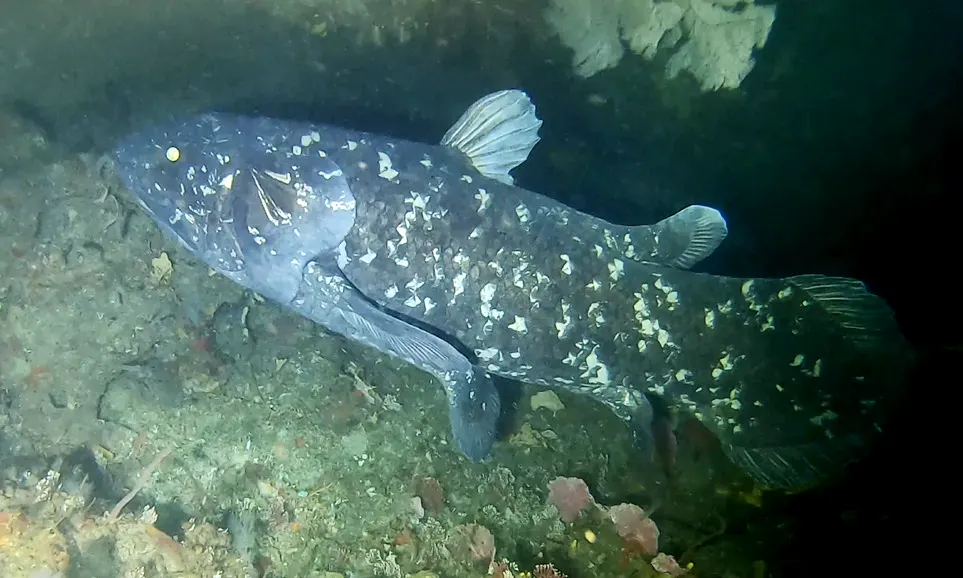
Living coelacanth hovering in a dark deep-reef cave, blue-grey with white flecks
A living West Indian Ocean coelacanth (Latimeria chalumnae) in a deep reef off Pumula, South Africa—one of very few images of this 'living fossil' alive in the wild.
SarcopterygiiCritically Endangered

Coelacanth Facts

“Coelacanths were known only from fossils, none younger than the Late Cretaceous, until a living one was landed off South Africa in December 1938.”

The West Indian Ocean coelacanth is a lobe-finned fish that rests by day in caves on steep slopes, mostly about 100–250 m (330–820 ft) deep. Coelacanths were known only from fossils until 1938; this species reaches about 2 m (6.6 ft), may live 100 years and is Critically Endangered.

By · Published · Updated

Quick Facts

Coelacanth at a glance

Latimeria chalumnae Coelacanthiformes Latimeriidae

About their home

Kind of animal

Sarcopterygii

Where they live

What they eat

How safe?

Critically Endangered

Size and speed

How heavy

82 pounds – 209 pounds

How long

3.3 feet – 6.6 feet

How fast

Slow drift-hunter that does not chase its prey

Lifespan

Probably about 100 years

How the Coelacanth compares

Measured against the 179 species profiled on this site. Each figure is converted to one unit system from the published range on the page, so the ranks are computed, not quoted.

MeasureThis speciesRank hereExceeds
Body mass94.8 kg#51 of 17972%
Body length2.01 m#46 of 17975%
Lifespan in the wild100 yr#2 of 17299%

Closest in body mass

Ranks use the upper end of each published adult range, so they compare typical large adults rather than records, and metrics with no published number are left out rather than estimated. The full table is downloadable from the species dataset, and any two species can be put side by side in the comparison tool.

Core article

Coelacanth: ecology and life history

A closer look at habitat, diet, behavior, reproduction, and conservation.

Start here

Coelacanth

The coelacanth is a large lobe-finned fish of the Indian Ocean. Adults reach about 2 m (6.6 ft) and 95 kg (209 lb), rest by day in caves on steep underwater slopes, mostly about 100–250 m (330–820 ft) below the surface, and drift out alone at night to hunt fish and squid. Scientists knew coelacanths only from fossils, none younger than the Late Cretaceous, until a living one was landed off South Africa in December 1938. The species is Critically Endangered; its best-studied population, off Grande Comore, numbers about 300–400 adults, and no one has counted the whole species.

This profile describes the West Indian Ocean coelacanth (Latimeria chalumnae), the species named from that 1938 fish and the one most studied. A second living species, the Indonesian coelacanth (Latimeria menadoensis), was found off North Sulawesi in the late 1990s; differences are noted below. Why the fish is called a "living fossil", and why biologists debate the term, is covered in why the coelacanth is called a living fossil.

Taxonomy and Evolution

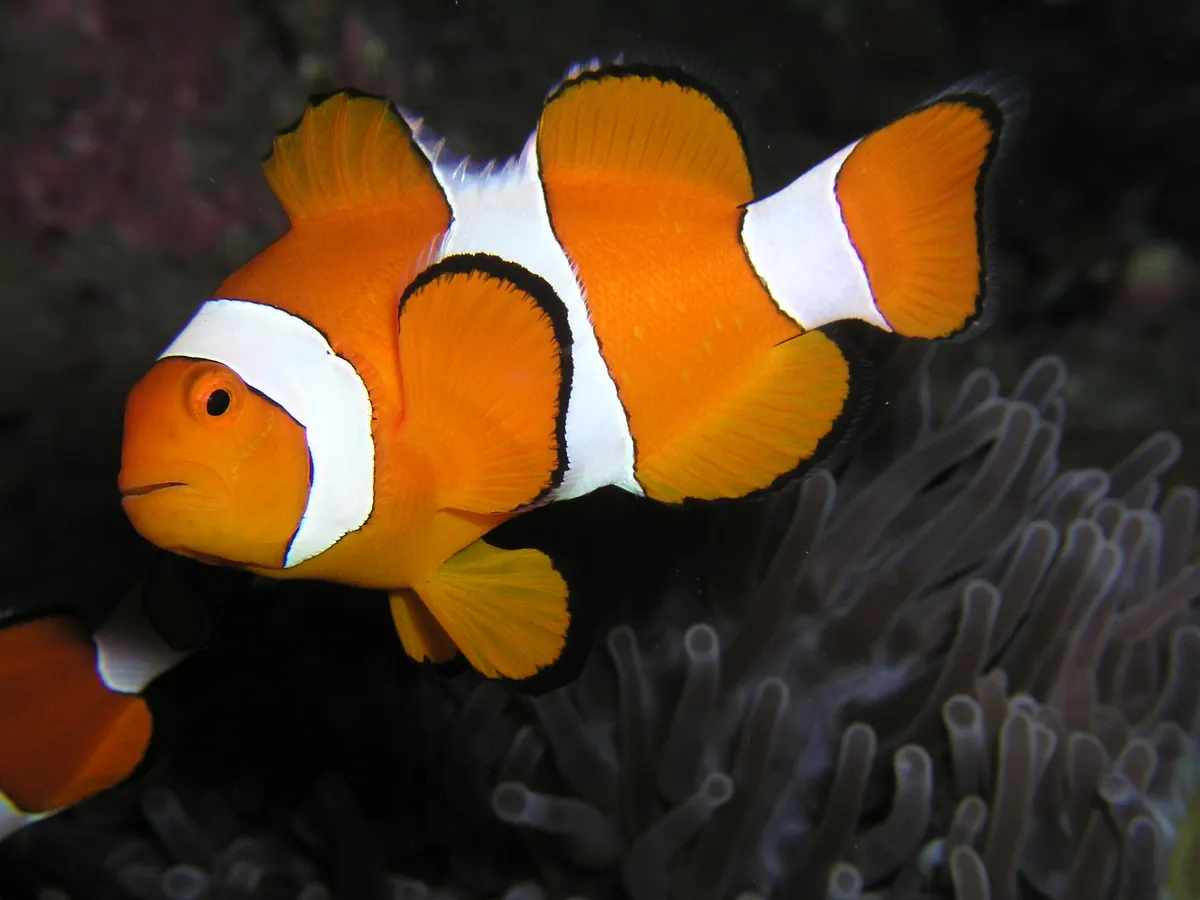
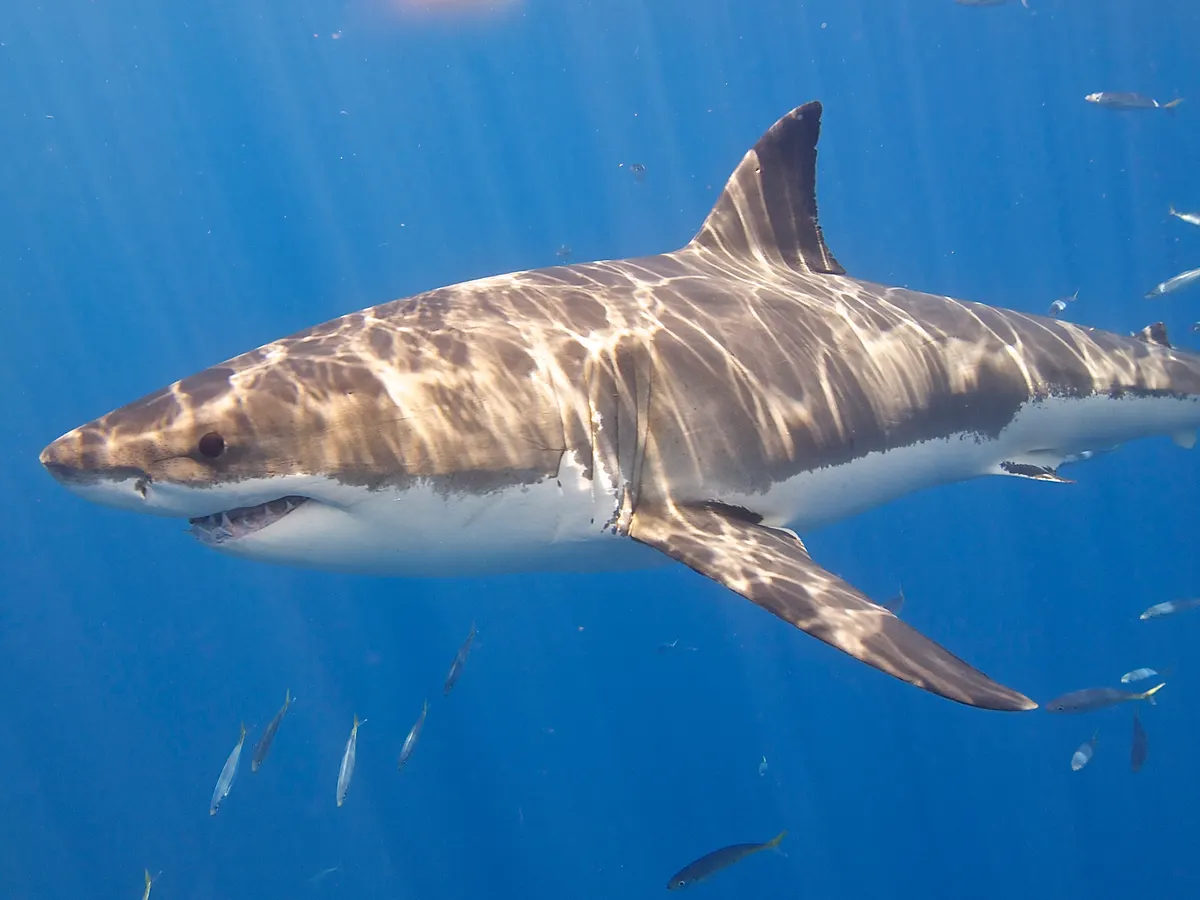
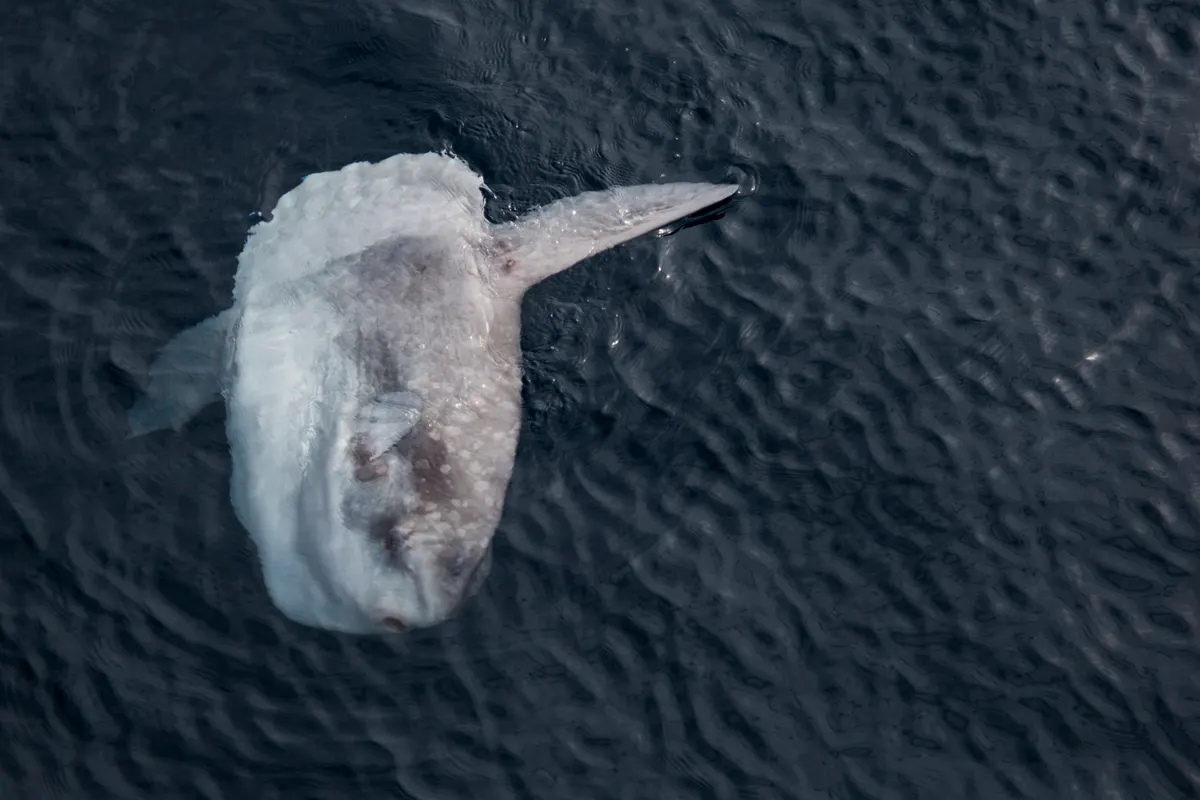
Coelacanths are lobe-finned fishes (class Sarcopterygii). Both living species are in the genus Latimeria, family Latimeriidae, order Coelacanthiformes. Their closest living relatives are the lungfish and the four-limbed vertebrates, or tetrapods: the 2013 genome study confirmed that lungfish, not coelacanths, are the closest living fish relatives of tetrapods, so the coelacanth is a side branch rather than an ancestor of land animals. Most other fish profiled here are more distant relatives: the ocean sunfish and clownfish are ray-finned fishes (class Actinopterygii), and the whale shark and great white shark are cartilaginous fishes.

The coelacanth fossil record begins in the Lower Devonian, about 419–411 million years ago, and more than 175 fossil coelacanth taxa have been described from the Palaeozoic and Mesozoic eras. Their diversity peaked in the Triassic. When the living fish was found in 1938, the group was believed to have been extinct since the Late Cretaceous, roughly 66–70 million years ago.

The lineage has not stood still since then. A 2024 analysis of all known coelacanths found that major new anatomical features essentially stopped appearing after the mid-Cretaceous, while body proportions and counted (meristic) traits kept changing at typical Mesozoic rates; coelacanths evolved faster during periods of high global tectonic activity. In overall body shape and lower-jaw shape, Latimeria is quite distinct from its Mesozoic relatives. The 2013 genome study found that coelacanth protein-coding genes have changed at about half the rate of tetrapod genes since the two lineages split, although the genome as a whole showed no sign of low flexibility.

Anatomy and Physical Characteristics

Coelacanths mix features found in different fish groups. They have bony scales and skull bones like other bony fishes and a three-lobed (diphycercal) tail found among living fishes only in coelacanths and lungfishes, but rely on fat for buoyancy and give birth to live young, traits usually found in cartilaginous fishes such as sharks and rays. The main features are:

  • Lobed fins. Of its eight fins, all but the first dorsal fin have fleshy bases; the pectoral, pelvic, second dorsal and anal fins sit on limb-like lobes. The pectoral and pelvic pairs move in a diagonal, alternating pattern, like the legs of a walking four-legged animal.
  • Notochord. Instead of a column of bony vertebrae, the body's main support is a notochord, a hollow tube filled with fluid.
  • Intracranial joint. Coelacanths are the only living vertebrates with a joint inside the skull, worked by its own (basicranial) muscle. Whether it mainly aids suction feeding or increases bite force is disputed.
  • Fatty organ and vestigial lung. A fat-filled organ does the job of a swim bladder. Inside it is a small, non-functional lung surrounded by small hard plates.
  • Rostral organ. An organ in the snout is believed to sense weak electric fields.
  • Scales and pattern. On film the fish looks iridescent dark blue; under natural light it is light brown with white blotches. Each fish's blotch pattern is unique and is used to identify individuals, and the pattern resembles the walls of the Comoros caves, which may help to hide it.
  • Eyes. Most light at their depth has a wavelength of about 480 nm, and their visual pigments are most sensitive to 478 and 485 nm, in the blue part of the spectrum.

Females are larger than males. Adult females average about 170 cm (5.6 ft) and 82 kg (181 lb), males about 125 cm (4.1 ft) and 37 kg (82 lb). Laser measurements of free-swimming adults off Grande Comore ranged from 100 to 200 cm (3.3–6.6 ft), and the heaviest published weight is 95 kg (209 lb). The Indonesian coelacanth is known from fewer fish; FishBase lists its maximum length as 140 cm (4.6 ft).

Habitat and Distribution

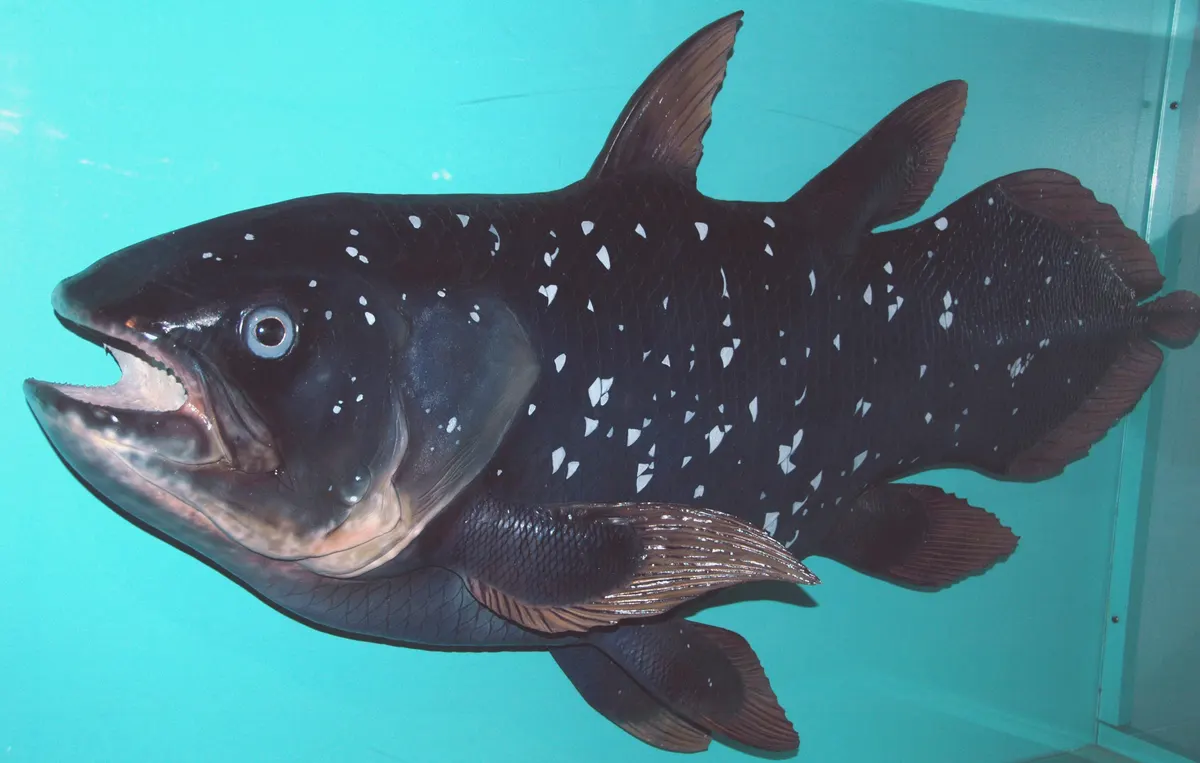
Preserved coelacanth specimen displayed in a museum case
Almost everything known about coelacanth anatomy came from preserved specimens like this one; living fish stay 500 to 2,300 feet down in volcanic cave systems and are rarely filmed.

The largest known population of the West Indian Ocean coelacanth lives off Grande Comore and Anjouan in the Comoros. Coelacanths have also been caught or seen underwater off South Africa, Mozambique, Tanzania, Kenya and Madagascar. The Indonesian coelacanth is known mainly from North Sulawesi, with records off Western New Guinea (Waigeo and Biak) and, since 2025, North Maluku, roughly 10,000 km (6,200 mi) from the Comoros.

By day, adults shelter in caves and under overhangs on steep, rocky slopes. Off Grande Comore they occupy volcanic slopes at about 170–240 m (560–790 ft), while the Tanzanian population uses limestone terraces at 70–140 m (230–460 ft). At night individuals have been recorded from about 70 to 700 m (230–2,300 ft). The Indonesian species is thought to live on similar rocky slopes at about 150–200 m (490–660 ft).

"Deep-sea fish" needs that context. NOAA puts the boundary between the sunlight zone and the twilight zone at 200 m (660 ft), and the abyssal zone begins at 4,000 m (13,100 ft). Coelacanths live around the 200 m boundary, thousands of metres above the abyssal sea floor. FishBase classifies the species as demersal, meaning it lives on or near the bottom.

Water temperature limits where they rest. Their daytime caves are usually about 16–22 °C (61–72 °F). In 1994, when water at cave depth off Grande Comore warmed to 25.1 °C (77 °F), fewer coelacanths used the surveyed caves, and researchers suggested some had moved into deeper, colder water.

Diet and Feeding Strategies

Life-size model of a coelacanth built from specimen measurements
No one has filmed a coelacanth feeding in the wild; diet is reconstructed from stomach contents of specimens, which held fish and squid.

Coelacanths are opportunistic carnivores. NOAA lists cephalopods, cuttlefish, eels and deep-water fish among their prey, and FishBase summarises the diet as fishes and squid. Fish identified as prey include the splendid alfonsino (Beryx splendens), the goatsbeard brotula (Brotula multibarbata), Lucigadus ori and Coranthus polyacanthus.

They hunt alone at night, drifting slowly over the bottom. In the few feeding observations made so far, coelacanths did not chase prey but snapped up suitable animals that passed within about 20 cm (8 in) of the mouth. Tagged fish travelled 2–8 km (1.2–5 mi) in a day, and individuals return to their resting caves in the early morning. Their fins let them swim in any direction, and they have been seen swimming upside down or hanging head-down in a vertical posture. The intracranial joint probably plays an important role in feeding, but how it is used has not been resolved.

Social Structure and Behavior

Preserved coelacanth on display at the Royal Museum for Central Africa
Coelacanths are not social; each fish shelters alone by day, and what is known of them comes largely from preserved animals like this.

Coelacanths share daytime caves, but no social interaction has been observed within these groups. Over 18 years of submersible counts off Grande Comore, researchers recorded groups of 11–14 fish in one cave on nine occasions; the largest group seen was 16. They never observed aggression, and the groups did not appear to form for mating. Physical contact between resting fish appears accidental.

Individuals are faithful to an area rather than to one cave. They occupy large, overlapping home ranges, some used by the same fish for up to 21 years, and move between several caves within them. Each fish leaves its cave alone after dark and returns to one of its regular caves in the early morning.

Life Cycle and Reproduction

Replica of a developing subadult coelacanth
Gestation is estimated to take several years before fully formed pups are born.

Coelacanths reproduce very slowly. Fertilization is thought to be internal, and the young develop inside the mother, supported by yolk, until they are born alive. Pregnant females have carried 5 to 26 well-developed pups; counts of 60 or more eggs at earlier stages suggest that brood size falls during pregnancy. Pups are born at about 35 cm (14 in) long.

A 2021 study that counted annual growth rings on the scales of 27 specimens re-estimated the species' life history: gestation of about five years, which may be the longest of any vertebrate; sexual maturity at 40–69 years; and a lifespan probably around 100 years. The oldest fish in the sample was 84. Earlier scale studies had put the maximum age at about 20 years, and gestation had been estimated at about three years. A separate population study off Grande Comore, based on adult death rates, estimated longevity at about 103 years.

Young coelacanths are rarely seen. In 21 years of surveys off Grande Comore, researchers found no fish shorter than 100 cm (3.3 ft) in their census area and only one subadult of about 50–60 cm outside it, and they concluded that juveniles live deeper than adults. A coelacanth of birth size was filmed off Indonesia at about 160 m (525 ft) in 2009.

Conservation Status and Threats

Preserved coelacanth specimen held in a museum collection
Museum specimens mapped the species' range: the western Indian Ocean, off Comoros, Tanzania, Mozambique and South Africa.

The IUCN Red List classifies the West Indian Ocean coelacanth as Critically Endangered (assessment dated 2000) and the Indonesian coelacanth as Vulnerable (assessment dated 2008). Both species are listed on CITES Appendix I, which bans international trade, and in 2016 the United States listed the Tanzanian population as threatened under the Endangered Species Act.

How many coelacanths are left is known only for parts of the range. The best-studied population, off Grande Comore, was estimated in 2011 at about 300–400 adults, and counts in an 8 km (5 mi) stretch of its coast stayed between 52 and 59 fish in 1991, 2000 and 2008. NOAA describes the Tanzanian population as likely small and isolated, having diverged from other populations about 200,000 years ago. The 2013 genome paper noted that only 309 individual coelacanths had been recorded in the 75 years after 1938.

The main threat is accidental capture. Coelacanths are considered unfit to eat and are not a target species, but they are hooked at night by Comorian fishers using hook-and-line gear for oilfish (Ruvettus pretiosus) and caught in deep-set shark gillnets off Tanzania. After deep-water gillnetting began in Tanzania in 2003, about 13 coelacanths a year were caught there, compared with about 0.3 a year at Grande Comore after 2000. NOAA also lists habitat damage from deep-water port construction, including channel dredging and submarine blasting. The authors of the 2021 life-history study concluded that such a slow life history means coelacanths may be more threatened than previously considered.

References and Authoritative Sources

Coelacanth: classification and fun facts

Classification

Scientific Taxonomy
  1. Kingdom

    Animalia

  2. Phylum

    Chordata

  3. Class

    Sarcopterygii

  4. Order

    Coelacanthiformes

  5. Family

    Latimeriidae

  6. Genus

    Latimeria

  7. Species

    L. chalumnae

Did You Know?

Fun Facts

1

Coelacanths were known only from fossils, none younger than the Late Cretaceous, until a living one was landed off South Africa in December 1938.

2

Instead of a column of bony vertebrae, a coelacanth's body is supported by a notochord, a hollow tube filled with fluid.

3

Its pectoral and pelvic fins grow from fleshy lobes and move in a diagonal, alternating pattern, like the legs of a walking four-legged animal.

4

Each coelacanth has its own pattern of white blotches, which researchers use to recognize individual fish across years of surveys.

5

Coelacanths are the only living vertebrates with a joint inside the skull, the intracranial joint; whether it aids suction feeding or bite force is still disputed.

6

Gestation is estimated at about five years, possibly the longest of any vertebrate.

Common Questions

FAQ about Coelacanth

Select a question to reveal the answer.

How big is a coelacanth?

Adult coelacanths measured with lasers off Grande Comore were 100–200 cm (3.3–6.6 ft) long. Females are larger: adult females average about 170 cm (5.6 ft) and 82 kg (181 lb), males about 125 cm (4.1 ft) and 37 kg (82 lb). The heaviest published weight is 95 kg (209 lb). Pups are born at about 35 cm (14 in).

What do coelacanths eat?

Coelacanths are opportunistic night hunters of fish and cephalopods. Recorded prey includes cuttlefish, squid, eels and deep-water fish such as the splendid alfonsino (*Beryx splendens*) and the goatsbeard brotula (*Brotula multibarbata*). They drift slowly over the bottom and snap up prey that passes within about 20 cm (8 in) of the mouth rather than chasing it.

How deep do coelacanths live?

By day they rest in caves on steep slopes, mostly about 100–250 m (330–820 ft) down: about 170–240 m (560–790 ft) off Grande Comore, and 70–140 m (230–460 ft) on limestone terraces off Tanzania. At night they have been recorded from about 70 to 700 m (230–2,300 ft). That is around the 200 m (660 ft) boundary between the ocean's sunlight and twilight zones, far above the abyssal zone, which begins at 4,000 m (13,100 ft).

Where do coelacanths live?

The West Indian Ocean coelacanth's largest known population lives off Grande Comore and Anjouan in the Comoros, and others have been caught or seen off South Africa, Mozambique, Tanzania, Kenya and Madagascar. The second species, the Indonesian coelacanth, lives off North Sulawesi and parts of eastern Indonesia, about 10,000 km (6,200 mi) away.

How many coelacanths are left?

No one has counted the whole species. The best-studied population, off Grande Comore, was estimated in 2011 at about 300–400 adults, and counts in its core study area stayed between 52 and 59 fish in 1991, 2000 and 2008. Other groups, including the small, isolated Tanzanian population, are less well known, and fewer data exist for the Indonesian coelacanth. By 2013 only 309 individual coelacanths had been recorded since 1938.

Is the coelacanth extinct or endangered?

It is not extinct: two species are alive today. The IUCN Red List classifies the West Indian Ocean coelacanth as Critically Endangered and the Indonesian coelacanth as Vulnerable. Both are on CITES Appendix I, which bans international trade, and the United States lists the Tanzanian population as threatened. The main threat is accidental capture on deep-set lines and in shark gillnets.

Show 4 more questionsExpand
How long do coelacanths live?

Probably about 100 years. A 2021 study of annual growth rings on the scales of 27 specimens found the oldest was 84, estimated sexual maturity at 40–69 years and gestation at about five years. Earlier scale studies had suggested a maximum age of about 20 years.

How many species of coelacanth are there?

Two living species, both in the genus *Latimeria*: the West Indian Ocean coelacanth (*L. chalumnae*), named from the 1938 specimen, and the Indonesian coelacanth (*L. menadoensis*), discovered in 1997 and named in 1999. More than 175 fossil coelacanth taxa have also been described.

Why is the coelacanth considered a living fossil?

Coelacanths were known only from fossils, none younger than the Late Cretaceous, until a living one was caught in 1938, and the living fish shares many anatomical features with its fossil relatives. The label is debated; see why the coelacanth is called a living fossil.

How does a coelacanth reproduce?

Fertilization is thought to be internal, and the young develop inside the mother, supported by yolk, until they are born alive. Pregnant females have carried 5 to 26 well-developed pups, which are born at about 35 cm (14 in) long after a gestation now estimated at about five years.

For school and research

Cite this page

APA
Nguyen, A. (2026, November 1). Coelacanth Facts. Wildlife Encyclopedia. https://www.wildlifedb.com/animals/coelacanth
MLA
Nguyen, An. “Coelacanth Facts.” Wildlife Encyclopedia, 1 Nov. 2026, www.wildlifedb.com/animals/coelacanth.