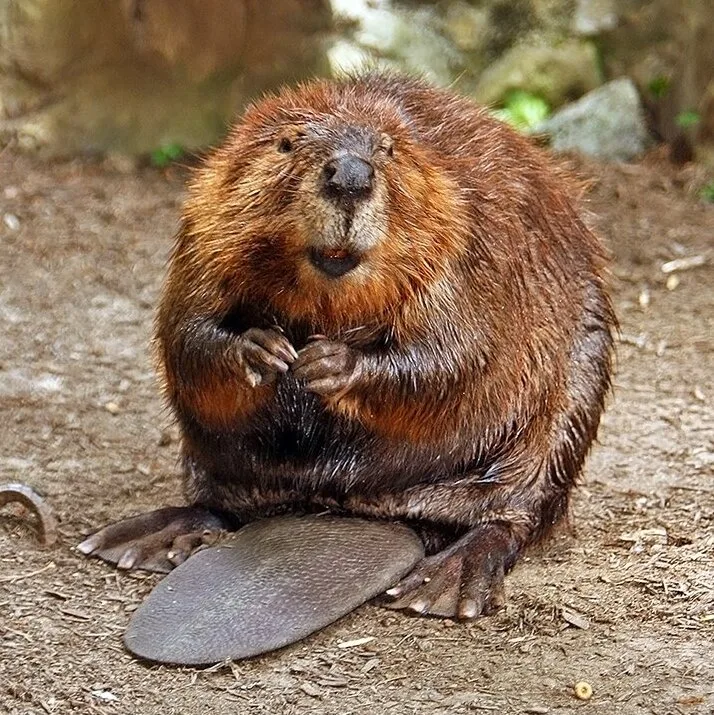
American beaver sitting upright with its broad flat tail visible
An American beaver shows its broad, flat tail and small, rounded ears.
MammaliaLeast Concern

American Beaver Facts

“Beavers store branches underwater as a winter food supply.”

The American beaver is a freshwater rodent that eats plants and can build dams to retain water. Its lodges, food caches, and family groups shape North American wetlands.

By · Published · Updated

Quick Facts

American Beaver at a glance

Castor canadensis Rodentia Castoridae

About their home

Kind of animal

Mammalia

Where they live

What they eat

How safe?

Least Concern

Size and speed

How heavy

35 pounds – 65 pounds

How long

3 feet – 4 feet

How fast

—

Lifespan

Typically about 10 to 12 years in Smithsonian and Alaska accounts

How the American Beaver compares

Measured against the 179 species profiled on this site. Each figure is converted to one unit system from the published range on the page, so the ranks are computed, not quoted.

MeasureThis speciesRank hereExceeds
Body mass29.5 kg#74 of 179#55 of 93 Mammalia59%
Body length1.22 m#83 of 179#53 of 93 Mammalia53%
Lifespan in the wild12 yr#110 of 172#61 of 88 Mammalia29%

Closest in body mass

Ranks use the upper end of each published adult range, so they compare typical large adults rather than records, and metrics with no published number are left out rather than estimated. The full table is downloadable from the species dataset, and any two species can be put side by side in the comparison tool.

Core article

American Beaver: ecology and life history

A closer look at habitat, diet, behavior, reproduction, and conservation.

Start here

American Beaver

The American beaver (Castor canadensis), also called the North American beaver, is a large plant-eating rodent that can change streams into ponds by building dams. It eats leaves, aquatic plants, and the bark and softer tissues of woody stems, rather than fish. A dam regulates water; a lodge is a shelter. They are different structures, and a beaver living beside sufficiently deep water may not need a dam at all.

A Flat Tail and Teeth That Keep Growing

A broad, scaly tail separates a beaver from many other swimming mammals. Its hind feet are webbed for propulsion, while smaller front paws grasp food, carry material, and manipulate branches. The Smithsonian describes typical adults as weighing 35–65 pounds (16–30 kg), with a total length around 3–4 feet, including the tail. This is a North American species; the Eurasian beaver is Castor fiber.

The orange front teeth contain iron-rich enamel and grow throughout life. Cutting and gnawing wear them down. These incisors are tools for both feeding and construction, but that does not mean every felled tree is used in a dam. A tree may supply edible bark, branches for storage, or material for a lodge.

The tail has several jobs: steering in water, providing support while working on land, storing fat, and slapping the surface as a warning. Its flexible front paws do much of the detailed handling, so watching the forefeet is useful when trying to understand how a beaver carries food or moves building material.

Where a Beaver Needs Water, Wood, and an Exit

American beaver standing at an opening in a bank lodge
A beaver pauses at a bank lodge along the Kanuti River during spring flooding.

American beavers are native to much of North America, using rivers, ponds, lakes, and other freshwater wetlands where suitable food and shelter occur. This profile describes the native North American range rather than treating introduced populations elsewhere as natural distribution.

A lodge is usually built from woody material and mud, with a chamber above water and entrances below the surface. In other settings, beavers use bank dens. Water around the entrance provides a route between shelter and feeding areas with less exposure on land. Suitable depth can come from an existing lake or river, or from water retained behind a dam.

That is why the absence of a dam does not prove the absence of beavers. Look instead for several kinds of evidence: cut stems, peeled branches, slides into water, a lodge or bank entrance, and the animal itself. A pile of sticks in a stream is not automatically an active beaver home, either; shelter and water-control structures need to be distinguished.

What Beavers Eat, and Why They Store Branches

American beaver feeding on green plants at a wetland edge
An American beaver feeds beside freshwater vegetation in Bombay Hook National Wildlife Refuge.

Beavers are herbivores. Their food includes aquatic plants, leaves, twigs, and bark, with willow, aspen, poplar, birch, and maple among the trees named by the Smithsonian. They do not routinely catch fish. Sharing a pond with fish does not give a beaver the diet of a sea otter, which is a carnivore.

In cold climates, branches stored underwater provide a winter food supply. The animal can reach this cache beneath ice and return to its lodge without making every meal a trip over frozen ground. Woody food is therefore both a resource to eat now and something to store before access becomes difficult.

Beavers remain active in winter rather than hibernating. Feeding from a cache, staying under ice, and spending time inside the lodge can make them less visible to observers. Lower winter visibility should not be interpreted as the colony having abandoned the pond.

Dams and Lodges Change Different Parts of a Stream

A dam slows or retains flowing water. Its effects can spread beyond the point where sticks cross a channel: water backs up, sediment settles, and saturated ground can support a different plant community. Yellowstone National Park describes beavers as a keystone species because their activity changes habitat structure and dynamics.

A lodge, by contrast, protects the animals themselves. A pond can contain a lodge without the lodge being the barrier that holds the pond back. Separating the two makes a beaver landscape easier to read: one structure manages water level, while the other provides a sheltered chamber.

The effects are not beneficial to every organism in every place. Flooding can damage roads, trees, and cultivated land; barriers and altered flow can affect fish differently depending on the stream. At the same time, retained water and new wetland habitat can support other wildlife. Understanding the site is more useful than describing all beaver dams as either damage or restoration.

Family Behavior Around a Shared Home

Two American beavers feeding together beside leafy pond vegetation
Two beavers eat beside Horseshoe Lake in Denali National Park.

Beavers generally live in family groups containing a breeding pair, the current year's kits, and older offspring. The Smithsonian describes yearlings and sometimes older nonbreeding young sharing the lodge and food supply. These are related family members, rather than an unrestricted gathering of unrelated adults.

Scent marking helps define occupied areas, and tail slaps can signal danger. Activity is mainly nocturnal, although a beaver can be visible in daylight or around dusk. Water gives it a practical retreat from predators such as wolves and coyotes; carrying branches across land exposes it in a different way.

The family structure also explains why one sighting does not reveal colony size. Several animals can use the same shelter, feed at different times, and remain submerged or inside when an observer is present. A photograph of two animals is evidence of two visible beavers, not a complete census.

Life Cycle: Kits Grow Up in the Colony

Adult American beaver with a smaller youngster on a wooden platform
A camera records an adult beaver with a young family member at Meadowbrook Pond.

American beavers usually produce one litter each year. Animal Diversity Web describes one to four kits and a gestation of about 105–107 days. Exact breeding and birth timing varies with location. Kits are born furred and with open eyes, and begin swimming early, although independence comes much later.

Young commonly remain with their parents for about two years, helping with activities around the home before dispersing. This creates a family containing more than one age class. The Smithsonian gives a typical lifespan of about 10–12 years; broader records can include longer-lived animals, so this is not a hard upper limit.

Conservation After a History of Heavy Trapping

American beaver among branches beside wooded freshwater habitat
A beaver in Algonquin Provincial Park illustrates the species' native Canadian freshwater habitat.

The species is Least Concern globally, as presented by Animal Diversity Web. Historical trapping greatly reduced beavers across parts of their native range, followed by substantial recovery. Present-day management still includes conflicts over flooding, roads, crops, and timber. A global conservation category does not settle the best response at a particular culvert or stream, where local conditions and wildlife authorities matter.

References for Beaver Biology and Wetlands

American Beaver: classification and fun facts

Classification

Scientific Taxonomy
  1. Kingdom

    Animalia

  2. Phylum

    Chordata

  3. Order

    Rodentia

  4. Family

    Castoridae

  5. Genus

    Castor

  6. Species

    C. canadensis

Did You Know?

Fun Facts

1

Beavers store branches underwater as a winter food supply.

2

A dam retains water, while a lodge provides shelter; they are different structures.

3

Beavers are herbivores and do not routinely catch fish.

4

Their orange incisors contain iron-rich enamel and continue growing throughout life.

5

Young often stay with their parents for about two years.

Common Questions

FAQ about American Beaver

Select a question to reveal the answer.

What do American beavers eat?

They are herbivores that eat leaves, aquatic plants, twigs, bark, and softer tissues of woody stems. Willow, aspen, poplar, birch, and maple are among their food trees.

Do beavers eat fish?

American beavers do not routinely catch fish. They are plant eaters, even though fish and other aquatic animals share their ponds.

Why do beavers build dams?

Dams retain water around shelters and feeding routes. Beavers living beside sufficiently deep water may use a lodge or bank den without building a dam.

What is the difference between a beaver dam and a lodge?

A dam is a barrier that slows or retains flowing water. A lodge is a shelter with an interior chamber, usually above water level and reached through underwater entrances.

Do beavers hibernate?

No. They remain active in winter. In cold climates they can travel under ice between their lodge and branches stored underwater for food.

What is a baby beaver called?

A baby is a kit. American beavers usually have one litter each year, commonly one to four kits. Young often remain with their parents for about two years.

Show 2 more questionsExpand
How big is an American beaver?

The Smithsonian reports typical adults at 35–65 pounds (16–30 kg), about 3–4 feet long including the tail. Larger individuals occur, so these are typical figures rather than absolute limits.

Are American beavers the same as Eurasian beavers?

No. The American or North American beaver is Castor canadensis. The Eurasian beaver is Castor fiber. This profile covers the North American species and its native range.

For school and research

Cite this page

APA
Nguyen, A. (2026, November 5). American Beaver Facts. Wildlife Encyclopedia. https://www.wildlifedb.com/animals/american-beaver
MLA
Nguyen, An. “American Beaver Facts.” Wildlife Encyclopedia, 5 Nov. 2026, www.wildlifedb.com/animals/american-beaver.